Never Change Batteries Again: The Milesight WT102 Thermostat with Thermal Energy Harvesting
 Timo Wevelsiep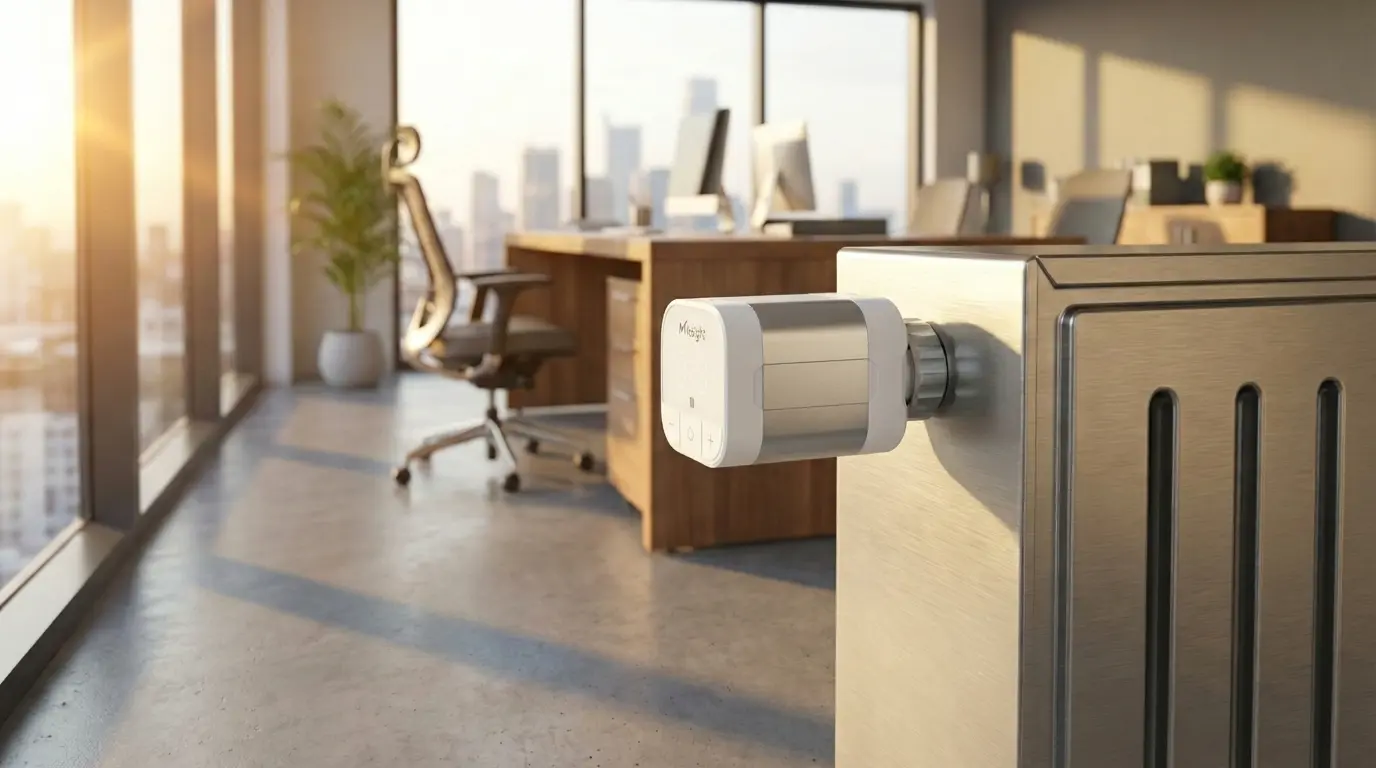
Content notice: The information in this article was compiled to the best of our knowledge at the time of publication. Technical details, pricing, versions, licensing models and external content are subject to change. Please verify the information independently, especially before making business-critical or security-relevant decisions. This article does not constitute individual professional, legal or tax advice.
In large buildings like hotels, schools, or office complexes, maintaining hundreds of IoT devices is often a logistical challenge. The most common reason for maintenance: battery replacement. With the Milesight WT102 Smart Radiator Thermostat, this problem is a thing of the past.
The WT102 is one of the first LoRaWAN® thermostats that powers itself completely. In this article, we explain the technology behind it and why "thermal energy harvesting" is the future of smart buildings.
1) The WT10x Series: An Overview
Milesight has launched two powerful models in the WT10x series:
- WT101: The battery-powered standard model with a lifespan of up to 10 years.
- WT102: The innovation model that operates autarkically through thermal energy harvesting.
Both devices offer precise temperature monitoring, automatic open-window detection, and a robust design with a metal housing. However, the WT102 goes a decisive step further towards maintenance-free operation. Milesight does not only cover sensors, though: the Milesight UC100 connects existing Modbus equipment via LoRaWAN.
2) The Secret: Thermal Energy Harvesting (Seebeck Effect)
The question we are most frequently asked: "How can a thermostat power itself if it doesn't have a solar cell?"
The answer lies in the heat of the radiator itself. The WT102 uses what is known as a thermoelectric generator (TEG).
How it works technically:
The physical principle behind it is the Seebeck effect. When two different semiconductor materials are exposed to a temperature difference, an electrical voltage is created.
- The thermostat is directly connected to the hot valve.
- The outer shell of the thermostat is exposed to the cooler room air.
The WT102 uses this temperature gradient to continuously generate small amounts of electricity. This energy is stored in an internal supercapacitor or rechargeable battery and powers the electronics, the LED display, and the motor that moves the valve.
Advantage: As long as there is heat, the device charges itself. A manual battery replacement is eliminated for the entire life of the device.
3) LoRaWAN® Class B: Immediate Response
Many battery-powered LoRaWAN devices operate in "Class A." This means they send data and are only reachable for commands shortly thereafter. If you want to change the temperature, you have to wait until the device "wakes up" the next time.
The Milesight WT102 supports LoRaWAN® Class B. In this mode, the device synchronizes with the gateway via beacons.
- Real-time control: Changes to the setpoint temperature are implemented almost without delay.
- Energy efficiency: Despite high reachability, energy consumption remains minimal, perfectly fitting the energy-harvesting concept.
4) Other Highlights of the WT102
In addition to its power supply, the WT102 offers several features that make it ideal for professional use:
- NFC Configuration: With the Milesight ToolBox app, the device can be configured in seconds without having to open it physically.
- Anti-theft Protection: Especially important in public buildings—a special lock prevents unauthorized removal.
- Child Lock: The local LED display and buttons can be locked.
- FUOTA (Firmware Updates Over-the-Air): Software updates can be deployed centrally via the network without anyone having to work on the radiator on-site.
- Universal Compatibility: Thanks to the included adapters, it fits almost any valve (M30, Danfoss RA/RAV/RAVL, etc.).
5) Use Case Examples: Where is the WT102 worth it?
Hotels
In hotels, occupancy fluctuates constantly. With the WT102, rooms can be automatically turned down when unoccupied. Since no batteries need to be changed, ongoing operations are not disrupted by maintenance work.
Schools and Public Buildings
Large buildings often have thousands of radiators. A battery replacement cycle here would take months and cause enormous personnel costs. The WT102 pays for itself in a very short time simply through the saved maintenance costs.
Office Complexes
Integration into a Building Management System (BMS) allows for precise heating curve optimization. In conjunction with LoRaWAN presence detectors, the heating can even pause automatically when no one is in the room.
6) What Happens in Summer?
A valid question: If the radiator stays cold in summer, no energy harvesting takes place. Milesight has prepared for this:
- Energy Reserve: The internal storage is sized to bridge the off-season.
- USB-C Port: If energy should run low (e.g., after long storage), the device can be quickly recharged via a hidden USB-C port.
Conclusion
The Milesight WT102 is more than just a smart thermostat. It is a prime example of sustainable IoT infrastructure. By combining thermal energy harvesting and LoRaWAN Class B, it solves two of the biggest problems in smart buildings: maintenance effort and response speed.
For companies looking to improve their carbon footprint while reducing operating costs, the WT102 is an investment that pays off in the long run.
Make Your Building Smart?
Are you planning to modernize your heating control or want to learn more about the Milesight WT10x series? merkaio supports you in planning, hardware procurement, and seamless integration into your existing systems.
Frequently Asked Questions
How does the self-powered principle work for the WT102?▼
What happens in summer when the heating is off?▼
Does the WT102 require batteries?▼
What wireless technology does the thermostat use?▼
Is the thermostat compatible with my radiators?▼

Written by
Timo Wevelsiep
Co-Founder
Co-Founder of merkaio. Building IoT infrastructure and managed operations. Focused on LoRaWAN, open-source IoT platforms and scalable sensor deployments.
LinkedInReady to build your IoT project?
From idea to production - we guide your IoT journey.