merkaio edge pro: The IoT Appliance Big Platforms Don't Want You to See
 Timo Wevelsiep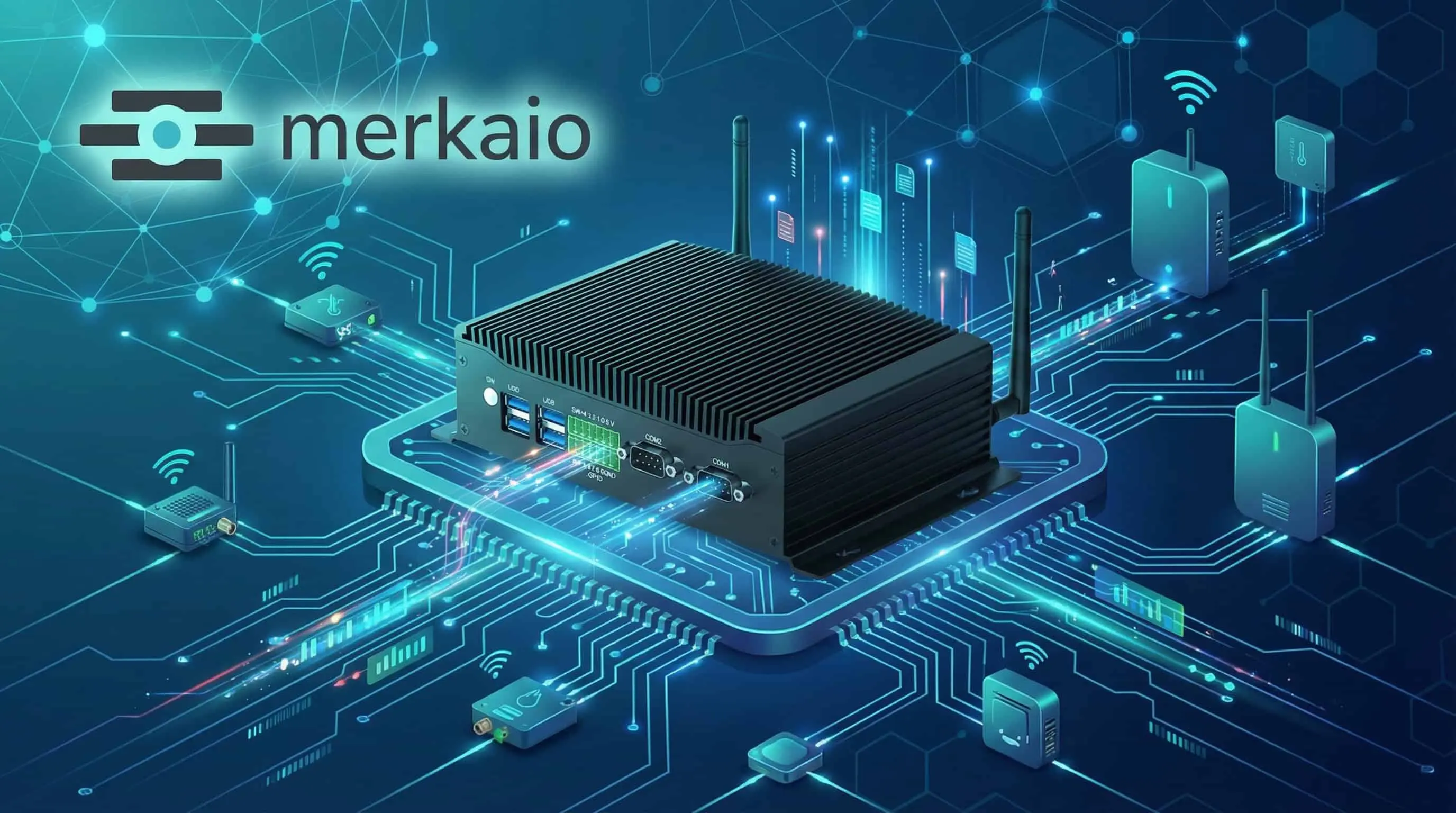
Content notice: The information in this article was compiled to the best of our knowledge at the time of publication. Technical details, pricing, versions, licensing models and external content are subject to change. Please verify the information independently, especially before making business-critical or security-relevant decisions. This article does not constitute individual professional, legal or tax advice.
Big IoT platforms hate this.
Not because it's sketchy. Because it challenges their business model.
We built an appliance that does what others charge monthly fees for – per sensor, per message, per gigabyte – for a one-time price. No cloud, no dependency, no billing surprises.
This is the merkaio edge pro.
The SaaS Pricing Problem in IoT
IoT cloud platforms have perfected a pricing model that looks affordable at first glance and gets expensive at second. The mechanics are always the same:
Per-device fees. A small monthly fee per sensor sounds harmless. At 10 sensors, it's manageable. At 100 sensors, it becomes noticeable. At 500 sensors, it becomes a budget risk – every month, for software running on the vendor's servers that you'll never own.
Per-message fees. Some platforms charge by message volume. A temperature sensor sending every 15 minutes generates roughly 3,000 messages per month. 100 sensors: 300,000 messages. Costs scale linearly – upward.
Data volume fees. Others charge by stored data volume. The moment you want historical analysis spanning months or years, costs scale linearly. Or the provider caps retention – and your long-term data is gone.
Hidden extras. API access, additional dashboards, SMS alerting, user licenses, white-label options – all extra. The entry price is a teaser. The real invoice looks different.
We analyzed this in detail in our previous post: The IoT Platform Trap shows how companies pay expensive licenses for software that's actually open source.
One-Time vs. Recurring: A Calculation
The fundamental difference between SaaS and edge infrastructure lies in the cost structure:
| Cost Item | IoT SaaS Platform | merkaio edge pro |
|---|---|---|
| Acquisition | Low to none | One-time investment |
| Monthly fees | Per sensor/message/data | None |
| Scaling costs | Linearly increasing with each device | Constant (up to hardware capacity) |
| Extra features | Usually paid | Included (open source) |
| Long-term costs | Continuous, unlimited | One-time + optional managed service |
| Cost planning | Variable, hard to calculate | Fixed, transparent |
Break-even for typical deployments is reached in a few months. After that, the appliance continues to operate cost-neutral – while SaaS fees continue year after year.
And this is before accounting for the fact that SaaS providers can raise prices at any time. Your hardware stays what it is.
Vendor Lock-in: The Real Problem
Recurring cost is one thing. The real risk is dependency.
Proprietary data formats. Many IoT platforms store your data in internal, undocumented formats. An export – if available at all – delivers CSV dumps without context at best. Device configurations, rules, dashboards? Not portable.
No database access. With most SaaS platforms, you have no direct access to the underlying database. Your data effectively belongs to the provider – not legally, but practically.
Platform shutdown. What happens when the provider gets acquired, triples their prices, or discontinues the service? You're left without infrastructure. Migration means: rebuild everything from scratch.
No interoperability. Proprietary APIs, custom device onboarding processes, incompatible data models. Every switch becomes a project.
This isn't theoretical risk. It happens. Regularly. And the larger your IoT deployment grows, the more painful a switch becomes.
The Alternative: merkaio edge pro
The merkaio edge pro is a different approach. Not a cloud service, but a physical appliance that sits in your network and belongs to you.
What it is: A fanless industrial PC in a rugged metal enclosure, optimized for DIN rail mounting in control cabinets. Pre-installed with a complete IoT stack – operational in under one hour.
What it replaces: The entire cloud IoT infrastructure. LoRaWAN network server, device management, database, dashboards, alerting, MQTT broker – everything runs locally.
What it costs: A one-time amount. No monthly fees, no per-device costs, no surprises.
The Tech Stack: 100% Open Source
Under the hood, the edge pro runs exclusively established open-source components:
ChirpStack – The LoRaWAN network server. Manages gateways, devices, and all radio communication. Supports all LoRaWAN-compatible sensors regardless of manufacturer: Milesight, Dragino, Decentlab, Elsys, and many more.
ThingsBoard – Device management and rule engine. Processes incoming data, controls devices, implements rules and workflows. The Community Edition is fully open source.
Grafana – Visualization and dashboards. Create unlimited dashboards for unlimited users. No user licenses, no dashboard limits.
Mosquitto – MQTT broker for communication between services and external systems.
Node-RED (optional) – Visual programming for data flows, transformations, and integrations.
Dedicated firewall – Cleanly separates the IoT network from corporate IT. Security by design, not by afterthought.
All these components are freely available. You could theoretically install and configure them yourself. The edge pro takes that work off your hands – professionally integrated, tested, and ready to operate.
And the crucial part: you have full root access. At all times. If you decide tomorrow to operate the box yourself or hire a different service provider – no problem. No call to sales, no activation, no fine print.
Offline-Capable and Latency-Free
One aspect cloud providers systematically downplay: internet dependency.
When your sensors run through a cloud platform and the internet connection drops, your dashboards freeze. Alerts don't fire. Data is lost or buffered at best.
The edge pro operates entirely locally. No internet needed – neither for LoRaWAN reception nor for data processing, visualization, or alerting. Everything runs on the local network, with millisecond latencies.
For critical infrastructure environments, production facilities, and anywhere downtime isn't an option, this isn't a feature – it's a prerequisite.
Use Cases: Where the edge pro Fits
Water and energy utilities. Remote monitoring that must work even during power outages and internet failures. Critical infrastructure-compliant data processing without cloud risk.
Manufacturing and shopfloor. Sensitive production data that must not leave the premises. Protection of intellectual property and compliance with industry standards like TISAX.
Healthcare and research. Strict separation of IoT data and sensitive patient networks. Privacy by design – not by contract clause.
Smart buildings and facility management. Indoor climate, energy monitoring, occupancy – all captured and visualized locally. Ideal for buildings with limited or unreliable internet connectivity.
Agriculture and remote sites. With the optional LTE module, the edge pro operates fully autonomously at sites without existing network infrastructure.
Optional: Managed Service Instead of DIY
Want the benefits of local infrastructure without the admin overhead? That's what merkaio ops is for.
Through a secure, outbound maintenance tunnel (no port forwarding, no firewall changes required), we handle:
- Updates and security patches – always current, always secure
- 24/7 monitoring – storage, temperature, system health
- Backup and disaster recovery – daily backups, fast restoration
- Secure maintenance tunnel – encrypted, initiated from inside
Cloud convenience. In your own server room.
Frequently Asked Questions
What exactly is the merkaio edge pro?▼
How does the edge pro compare economically to SaaS?▼
What software runs on the edge pro?▼
Does the edge pro work without internet?▼
What happens if the hardware fails?▼
Is there vendor lock-in with the edge pro?▼

Written by
Timo Wevelsiep
Co-Founder
Co-Founder of merkaio. Building IoT infrastructure and managed operations. Focused on LoRaWAN, open-source IoT platforms and scalable sensor deployments.
LinkedInReady to build your IoT project?
From idea to production - we guide your IoT journey.