IoT in the Hellweg Region: Opportunities for Soest, Werl & Unna
 Timo Wevelsiep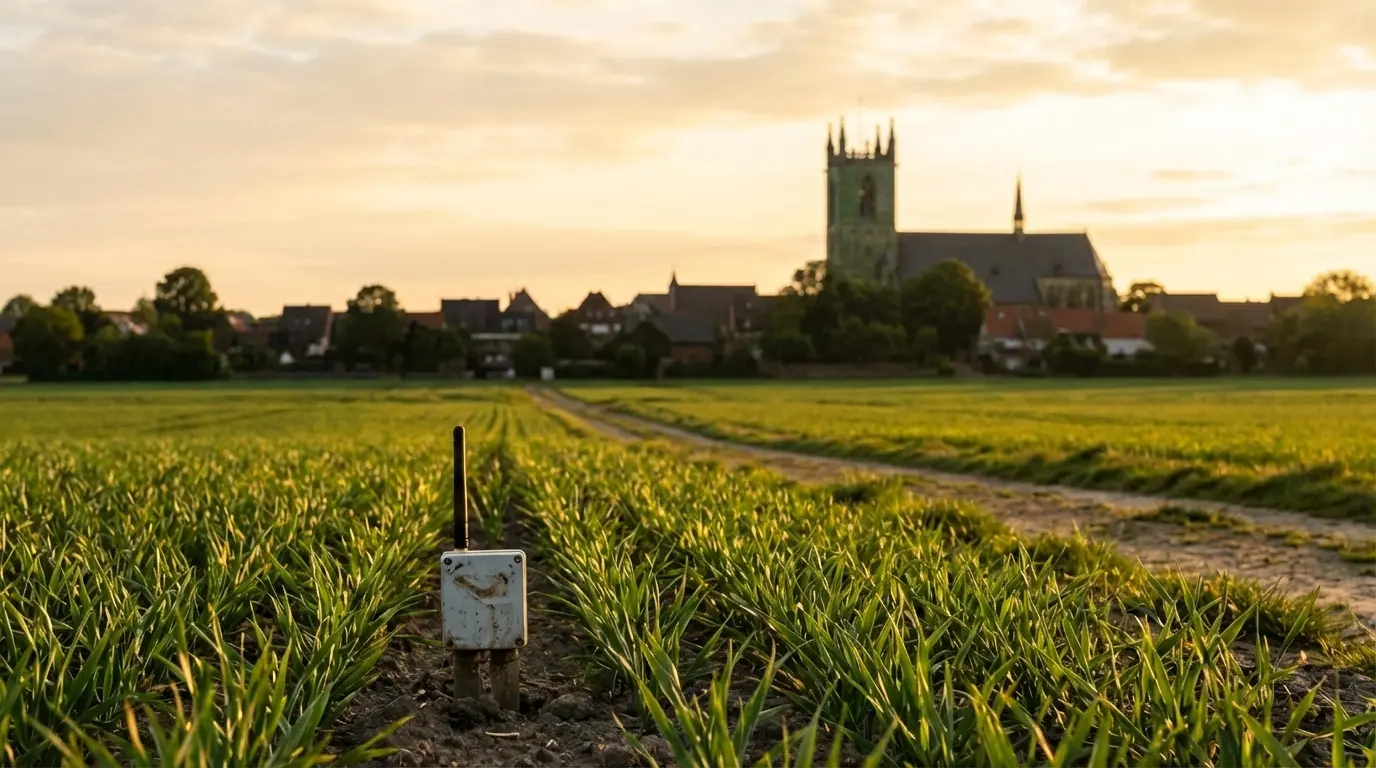
Content notice: The information in this article was compiled to the best of our knowledge at the time of publication. Technical details, pricing, versions, licensing models and external content are subject to change. Please verify the information independently, especially before making business-critical or security-relevant decisions. This article does not constitute individual professional, legal or tax advice.
The Hellweg region around Soest, Werl, and Unna is on the verge of a digital transformation. The Internet of Things (IoT) offers local businesses and municipalities in South Westphalia enormous opportunities: From smart farming on the fertile soils of the Soester Börde to Smart City applications in urban centers – IoT technologies make processes more efficient and improve quality of life.
IoT Infrastructure in the Hellweg Area
The fundamental prerequisite for IoT is a capable network infrastructure. Significant progress has been made in the region:
Fiber Optic and 5G
Broadband expansion is progressing: Throughout Kreis Soest, work is underway on a comprehensive fiber optic network with the goal of providing all households with gigabit-capable connections by 2030 at the latest. In parallel, mobile operators are investing in 5G expansion: The first 5G station in Soest was activated in 2021, followed by sites in Ense, Werl, Möhnesee, and other locations.
LoRaWAN – The Region's IoT Backbone
In addition to broadband and mobile networks, a dedicated IoT infrastructure based on LoRaWAN is emerging. The Stadtwerke Soest has operated its own LoRaWAN network since 2017 and is testing various use cases. LoRaWAN is a wireless network specifically developed for IoT with long range and minimal energy requirements – ideal for connecting sensors wirelessly.
Civil society initiatives are also getting involved: The The Things Network South Westphalia community is building an open, freely accessible IoT data network. The goal is to provide the entire region with IoT connectivity through a gateway network supported by citizens and businesses.
Smart City Initiatives in the Region
Model Project "5 for South Westphalia"
Soest was selected as one of the "5 for South Westphalia" as part of the federal Smart Cities Model Projects funding program. The city established a Smart City strategy in 2021 to become digitally connected, sustainable, and climate-neutral by 2030. Initial projects – from the Urban Data Platform to citizen apps to IoT-based climate sensors – are already being implemented.
Smart Region Kreis Unna
In Kreis Unna, all ten municipalities together with the district have formulated a vision for developing a Smart Region Kreis Unna. This inter-municipal alliance aims to advance the district as a connected business location between the Ruhr area, Münsterland, and South Westphalia – with shared digital platforms and the recognition that digitalization doesn't stop at city boundaries.
BürgerWOLKE Soest
A flagship project is BürgerWOLKE Soest, funded by the state of NRW. 100 low-cost sensor systems were installed throughout the city, delivering real-time climate data (temperature, humidity) via LoRaWAN to an Urban Data Platform. Together with the German Weather Service and the Fraunhofer Institute, the data is being used to improve urban climate models – a first step toward an Urban Climate Twin for Soest.
Application Areas with Local Relevance
Smart Farming in the Soester Börde
The Soester Börde with its fertile loess soils is ideally suited for Smart Farming. Farmers can use IoT to monitor soil moisture, weather data, and crop growth in real-time. Connected sensors continuously deliver data, enabling precise control of irrigation and fertilization.
At Haus Düsse (Bad Sassendorf), a Center for Digitalization in Agriculture was established in 2022. There, experts help farmers select suitable digital systems – from milking robots to data platforms – for their farms.
Energy and Building Management
Smart Metering enables electricity, gas, and water meters to be read wirelessly. The Stadtwerke Soest is already testing IoT-capable meters and LoRaWAN modules to detect water consumption and network leaks early.
For businesses, the Economic Development Agency of Kreis Soest offers the wfg.IOT-BOX – a device that allows existing machines to be easily retrofitted digitally. The captured consumption data helps identify optimization potential in energy use and supports CO₂ accounting.
Traffic and Mobility
As part of Smart Region Kreis Unna, the LuFtHub project is planned – an air quality and traffic data hub for the cities of Lünen, Fröndenberg, and Holzwickede. Environmental and traffic detectors along heavily traveled roads will deliver real-time data on particulate matter, noise, and traffic flow.
In Soest, smart parking systems are being tested via LoRaWAN: Apps or displays show where free parking spaces are available. Less search traffic means smoother traffic flow and fewer emissions.
Industry 4.0 in Local Business Parks
The Hellweg region is home to numerous medium-sized industrial and craft businesses. In business parks like Unna/Kamen or Gewerbepark Werl, production processes are increasingly digitally connected. Sensors on machines capture condition data and enable Predictive Maintenance – proactive maintenance before an expensive failure occurs.
For smaller businesses with older machine fleets, the wfg.IOT-BOX offers a simple retrofit solution: Power consumption, operating hours, and piece counts can be captured without major investment and visualized in Grafana or ThingsBoard.
Environmental Monitoring and Climate Protection
Beyond BürgerWOLKE, there are other environmental IoT applications:
- Air quality sensors can continuously measure particulate matter and NO₂ levels in polluted zones
- Level sensors on the Lippe and Ruhr rivers enable flood early warning
- Smart Waste: Fill level sensors in glass and paper recycling containers optimize collection routes
- Intelligent street lighting adjusts brightness to pedestrian traffic
Challenges in Regional IoT Implementation
Network Infrastructure and Standards
Even though fiber optic and 5G are expanding, gaps remain – particularly in rural outskirts. Building comprehensive LoRaWAN networks requires municipalities, utilities, and community initiatives to work together. Interoperability and open standards are crucial to avoid isolated solutions.
Data Protection and IT Security
Around 71% of German municipalities cite data protection and open legal questions as the biggest obstacles to adopting new digital technologies. IoT sensors and gateways must be secured against hacker attacks. Only when citizens and businesses have confidence in data security will IoT solutions gain broad acceptance.
Skilled Worker Shortage
The acute shortage of IT professionals hits smaller cities and municipalities particularly hard. Municipalities compete with the private sector for talent. Training, cooperation with the South Westphalia University of Applied Sciences in Soest, and regional competence centers like the one at Haus Düsse are important countermeasures.
Investments and Funding
IoT projects initially require investments in hardware, network technology, and software platforms. Many innovations are only possible thanks to funding from state, federal, or EU sources. It's important to set up pilot projects as proof of concept and make successes visible before scaling.
Conclusion: The Hellweg Region on the Path to Smart Region
The region around Soester Börde, Werl, and Unna already has a good foundation to benefit from the Internet of Things. Digital infrastructure – from broadband to LoRaWAN – is continuously improving, and showcase projects like BürgerWOLKE Soest clearly demonstrate the benefits.
With cooperation, foresight, and targeted funding, the IoT potential in the Hellweg area can be realized – whether in agriculture, energy efficiency, traffic management, industry, or environmental protection. In this way, the region will become not only more digital but also more future-proof and livable.
Planning an IoT project in the Hellweg region? We support municipalities and businesses in South Westphalia with the conception, implementation, and operation of IoT solutions – from LoRaWAN infrastructure to Managed Hosting to data visualization with Grafana and ThingsBoard.
Sources
- Broadband expansion – fast internet for underserved areas – Kreis Soest
- 5G for Kreis Soest: Vodafone expands infrastructure – Presseportal
- Innovation driver municipal utilities: LoRaWAN technology offers great potential – Stadtwerke Soest
- South Westphalia - The Things Network Community – The Things Network
- Smart City Soest – City of Soest
- Inter-municipal cooperation as a success model: Smart Region Kreis Unna – Smart City Dialog
- New Center for Digitalization in Agriculture – Chamber of Agriculture NRW
- New offering: Capture consumption data for CO2 accounting with the wfg.IOT-BOX – wfg Kreis Soest
- Soest is becoming more digital – including jobs at the city – Karriere Soest
- Future Radar Digital Municipality 2024 – German Association of Towns and Municipalities
- Municipal Administration - The biggest hurdles in digitalization – Grant Thornton
- LoRaWAN and IoT Solutions – Smart Cities: 5 for South Westphalia
Frequently Asked Questions
What is LoRaWAN and why is it important for the Hellweg region?▼
What Smart City projects exist in Soest?▼
How can farmers in the Soester Börde benefit from IoT?▼
What is BürgerWOLKE Soest?▼
What IoT funding programs are available in South Westphalia?▼
What is the 5G coverage status in Kreis Soest?▼
What is the wfg.IOT-BOX?▼
What challenges exist in implementing IoT in municipalities?▼
Written by
Timo Wevelsiep
Co-Founder
Co-Founder of merkaio. Building IoT infrastructure and managed operations. Focused on LoRaWAN, open-source IoT platforms and scalable sensor deployments.
LinkedInReady to build your IoT project?
From idea to production - we guide your IoT journey.