IoT in Healthcare: How Connected Sensors Are Revolutionizing Elderly Care
 Timo Wevelsiep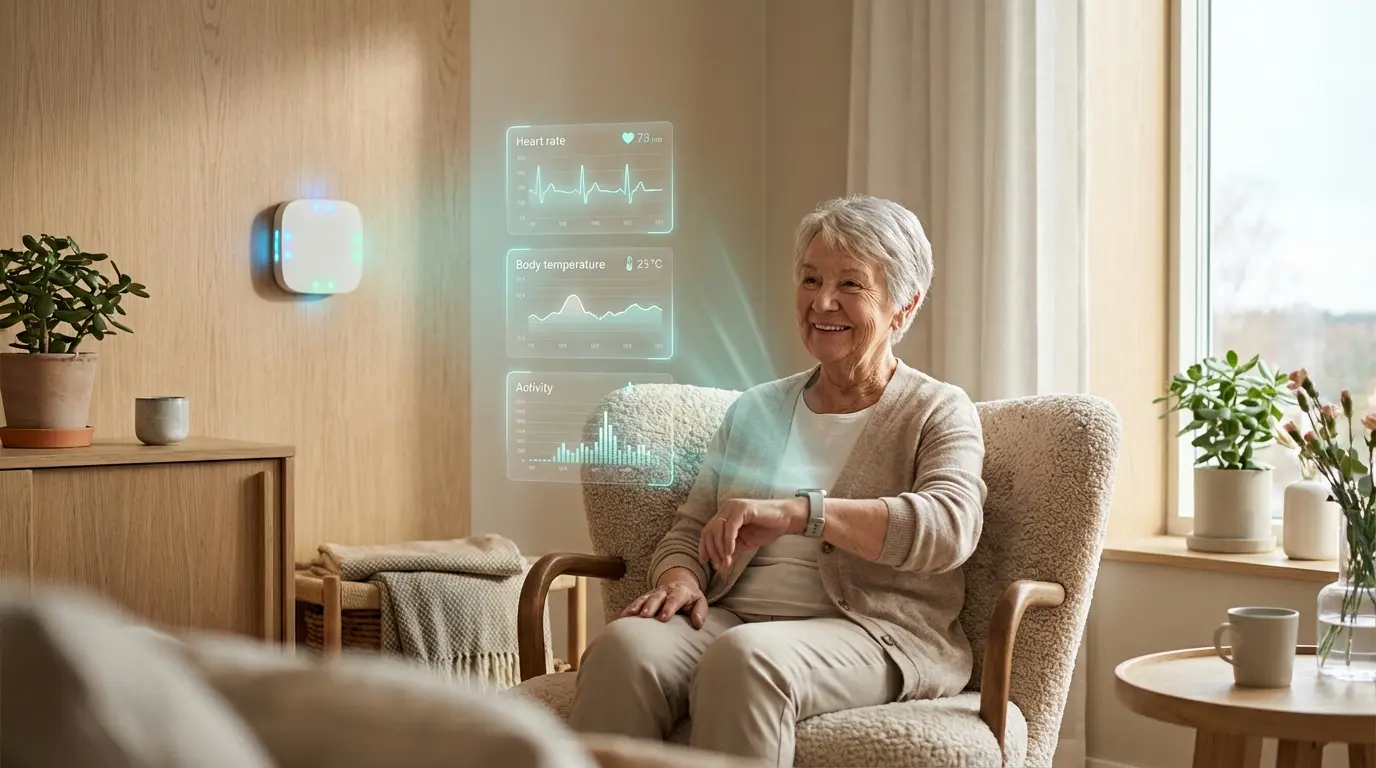
Content notice: The information in this article was compiled to the best of our knowledge at the time of publication. Technical details, pricing, versions, licensing models and external content are subject to change. Please verify the information independently, especially before making business-critical or security-relevant decisions. This article does not constitute individual professional, legal or tax advice.
Demographic change poses massive challenges for Germany. By the end of 2021, 4.9 million people were already in need of care – and the trend is rising. At the same time, there's a shortage of skilled workers: studies predict that several hundred thousand caregivers will be missing by 2040.
IoT technologies offer a way out of this dilemma. Connected sensors can enable older people to live longer, safer lives at home – and noticeably relieve caregivers.
Table of Contents
- The Challenge: More Care Recipients, Less Staff
- How IoT Helps in Care
- Application Scenarios
- Real-World Examples from the DACH Region
- Implementation Challenges
- Implement Healthcare IoT
- Sources
The Challenge: More Care Recipients, Less Staff
The numbers speak clearly:
- 4.9 million care recipients in Germany (2021)
- By 2050, the share of people over 80 will double
- Hundreds of thousands of missing caregivers by 2040
Nursing homes, outpatient services, and hospitals are reaching their limits. The solution cannot lie solely in more staff – technology must help close the care gap.
How IoT Helps in Care
Connected sensors and devices capture data in real-time and support caregivers with routine tasks, monitoring, and care delivery.
1. Vital Parameter Monitoring
Intelligent measuring devices continuously monitor health values such as pulse, blood pressure, blood sugar, or oxygen saturation. The data is automatically transmitted to caregivers or doctors – critical values trigger an immediate alarm.
2. Medication Management
Connected medication dispensers remind patients acoustically or via app to take their medication and automatically report whether doses were taken. Smart shelf systems monitor inventory and automatically trigger reorders.
3. Remote Monitoring and Telecare
IoT eliminates the need for constant physical presence. Caregivers can check patients' vital data at home daily via connected devices and intervene when anomalies occur – without having to be on-site constantly.
Application Scenarios
Inpatient Care and Hospitals
In hospitals and nursing homes, IoT helps with:
- Asset tracking: Important devices (blood pressure monitors, infusion pumps, wheelchairs) are always locatable
- Smart hospital: Medical devices automatically transmit vital parameters to patient management
- Building automation: Access control, room climate, lighting
Outpatient Care
Care services equip apartments with invisible sensors – motion detectors, door contacts, household appliance usage. Based on this data, caregivers can remotely assess whether the client is doing well.
Ambient Assisted Living (AAL)
A technology-supported living environment that increases safety and comfort in old age:
- Motion detectors register activities
- Smart medication dispensers monitor intake
- Emergency call systems with voice control
Real-World Examples from the DACH Region
EU Project ACTIVAGE (Germany)
The Fraunhofer IGD equipped 102 apartments and 71 nursing home rooms with a total of 4,250 sensor devices. The connected devices continuously collected data and helped capture residents' situations in real-time.
Result: The technology demonstrably extended independent living in old age and relieved care services.
→ Fraunhofer IGD: IoT-based Assistance Systems
AssistMe – Digital Care Assistant "alea" (Germany)
The Berlin startup has developed an IoT system specifically for nursing homes:
- Sensors in incontinence materials report when a change is needed
- A clip captures position changes and wandering tendencies
- All data flows into a care app
Result: Shortened response times, higher care quality, more satisfied employees.
→ AssistMe: Digital Solution for Nursing Homes
TeleCareHub (Austria)
The FH Vorarlberg is developing a platform for technology-supported dementia care. Sensors capture activities, and relatives stay informed via app.
→ TeleCareHub: Platform for Telecare
Implementation Challenges
Data Protection and Security
Connected devices collect highly sensitive health data. IoT systems must be end-to-end encrypted and GDPR-compliant.
User and Staff Acceptance
Training and simple operation are crucial. When caregivers recognize that smart assistants relieve them (rather than control them), willingness to use increases.
Infrastructure and Operations
IoT requires reliable networks – a challenge especially in older buildings with thick walls. LoRaWAN offers advantages here: long range, good penetration, low costs.
Many care facilities lack the IT staff for complex IoT structures. This is where Managed IoT Platforms come in.
Implement Healthcare IoT
Planning connected sensors for your care facility or clinic? merkaio guides you from requirements analysis to ongoing operations – technology selection, architecture, implementation, and operations.
Sources
Frequently Asked Questions
How can IoT help mitigate the caregiver shortage?▼
Can IoT be used in care settings in compliance with data protection?▼
Which wireless technology is suitable for care facilities?▼

Written by
Timo Wevelsiep
Co-Founder
Co-Founder of merkaio. Building IoT infrastructure and managed operations. Focused on LoRaWAN, open-source IoT platforms and scalable sensor deployments.
LinkedInReady to build your IoT project?
From idea to production - we guide your IoT journey.