IoT in Africa: Why the Continent Is Taking Off
 Timo Wevelsiep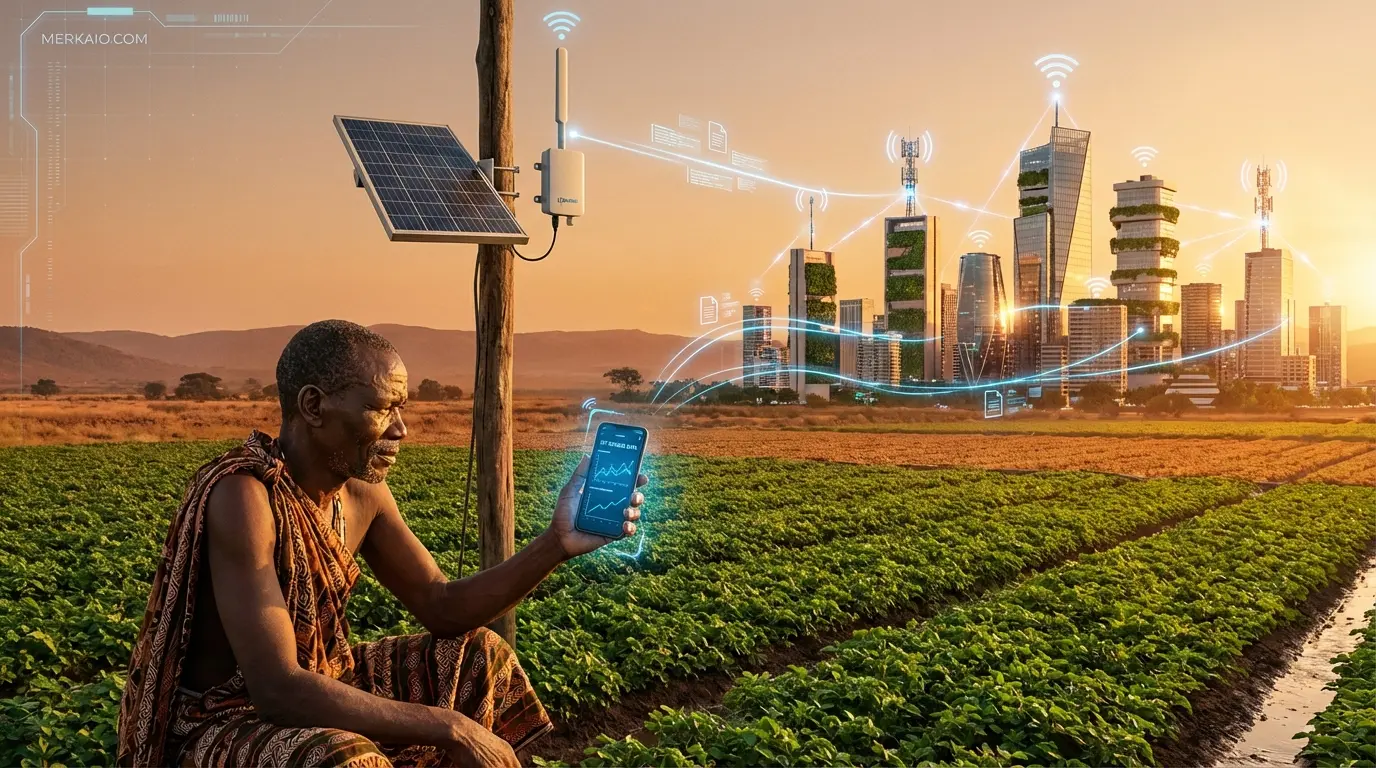
Content notice: The information in this article was compiled to the best of our knowledge at the time of publication. Technical details, pricing, versions, licensing models and external content are subject to change. Please verify the information independently, especially before making business-critical or security-relevant decisions. This article does not constitute individual professional, legal or tax advice.
1.3 billion people. 55 countries. The world's largest free trade zone. And a continent that's currently skipping entire stages of development.
While Europe debates whether 5G is really necessary, Africa is building IoT infrastructure that works without traditional broadband. It's called leapfrogging – and it's changing everything.
The Numbers That Change Everything
Let's start with the facts, because they're impressive:
- $239 billion – the projected size of the African IoT market by 2028
- 15.9% annual growth – significantly above the global average
- South Africa alone: from $5B (2022) to over $31B (2028) – that's +36% per year
- 53 million IoT connections expected in Sub-Saharan Africa by 2030
And this is just the beginning. By 2050, a quarter of the world's population will live in Africa. The pressure to digitize is mounting – and IoT is the key.
The Challenges (and Why They're Solvable)
Of course, there are hurdles. Only 38% of Africa's population uses the internet – the lowest rate worldwide. The telecom landscape is fragmented: no single provider covers an entire country. Many regions still operate on 2G/3G networks.
But here's where it gets interesting: these very limitations make IoT technologies like LoRaWAN and NB-IoT game-changers.
LoRaWAN doesn't need nationwide cellular coverage. A single gateway can serve hundreds of sensors over several kilometers – no SIM cards, no monthly per-device fees. Perfect for rural areas where traditional infrastructure is lacking.
Use Cases That Inspire
Enough theory. Let's look at what IoT is already achieving in Africa:
🌾 Smart Farming
Agriculture is the backbone of many African economies – and this is where IoT shows its full potential.
- Nigeria: Cassava farmers increase yields by 15–25% through IoT-enabled farm management
- Rwanda: Connected agricultural sensors reduce plant diseases by 50%
- Precision farming saves 30% water and 25% fertilizer
Startups like UjuziKilimo (Kenya) and Aerobotics (South Africa) are bringing sensors and drones directly to smallholder farmers. What was science fiction ten years ago is reality today.
More on this topic: IoT in Agriculture – Our Deep Dive
⚡ Energy & Pay-as-you-go
This is where it gets really exciting. In Kenya, the startup M-Gas developed an IoT-enabled prepaid system for cooking gas:
- NB-IoT-connected gas meters measure consumption in real-time
- Households pay via M-Pesa (mobile payment) – only for what they use
- 185,000 households in Nairobi already use the system
Similar models are emerging for solar home systems and water pumps. IoT makes basic utilities affordable – even for low-income households.
🏥 Healthcare & Telemedicine
In Rwanda, IoT systems play a key role in healthcare delivery:
- Patient data is transmitted in real-time from rural health stations to central clinics
- Doctors can diagnose and treat patients faster
- Wearables for pulse and blood sugar monitoring are becoming widespread
IoT is closing healthcare gaps – especially where doctors are scarce.
Related: IoT in Healthcare
🏙️ Smart Cities
Africa's metropolises are growing rapidly. IoT helps manage this growth:
- Johannesburg: IoT-enabled waste bins automatically report their fill level, smart lighting saves energy
- Lagos: Intelligent traffic light control reduces commute times
- Environmental monitoring measures air quality and flood risks in real-time
Mega-projects like Egypt's new capital or Eko Atlantic City in Nigeria are integrating IoT from the ground up.
Learn more: Smart City Solutions
🚛 Industry & Logistics
- Mining in South Africa: Predictive maintenance through IoT sensors reduces costly breakdowns
- Fleet management: GPS trackers are standard – for theft prevention and route optimization
- Supply chain: Real-time tracking across borders – crucial for the Pan-African free trade zone
The Pioneers: Which Countries Are Leading?
| Country | Highlight |
|---|---|
| South Africa | Largest market, 33% of companies planning IoT investments |
| Kenya | M-Pesa ecosystem, Safaricom as driver |
| Nigeria | Smart City Lagos, largest population |
| Egypt | New capital with IoT from the start |
| Tanzania | Growing tech hub scene |
Major telecom companies like MTN and Vodacom are investing heavily in 5G and IoT infrastructure. The Smart Africa initiative has launched a broadband offensive through 2025.
Hardware That Can Handle Africa
African conditions are demanding: extreme heat, dust, sandstorms, monsoon rains, unstable power supply. Consumer-grade hardware fails quickly here.
That's why we rely on Milesight – industrial-grade IoT hardware designed for exactly these environments:
What Sets Milesight Apart:
- IP67 protection rating – dust, sand, and water can't harm these sensors
- Operating temperature up to +85°C – perfect for the Sahel zone or tropical regions
- Solar-powered gateways – off-grid capable without power connection
- LoRaWAN-native – no SIM card per sensor, no monthly costs
Specific Products for Africa:
| Product | Use Case |
|---|---|
| UC500 IoT Controller | Solar + battery, ideal for remote sites |
| EM500 Series | Outdoor sensors for soil, water, weather |
| UG6x Gateways | Industrial grade, high range |
We rely on Milesight and know this hardware inside and out. We pre-configure everything in Germany – on-site, it's just: power on and go.
What This Means for IoT Projects in Africa
If you're thinking about IoT in Africa, here are our learnings:
- LoRaWAN over cellular dependency – No provider lock-in, no fragmented SIM landscape
- Local partners are essential – For installation, maintenance, and cultural understanding
- Mobile payment integration is a must-have – M-Pesa, MTN Mobile Money, Airtel Money
- Pre-provisioning in Germany – Hardware arrives configured and tested, plug & play on-site
- Choose robust hardware – IP67, extended temperature range, solar option
Conclusion: The IoT Revolution Starts Now
Africa is at the beginning of a technological transformation. The numbers speak for themselves: double-digit growth rates, billions in investments, innovative use cases from smart farming to pay-as-you-go energy.
Those who get in now position themselves early in one of the world's most dynamic markets. The challenges – infrastructure, connectivity, harsh conditions – are solvable. With the right technology and the right partners.
We're already working on projects in Africa. Robust hardware, LoRaWAN expertise, remote-first operations – that's exactly what the continent needs.
Learn more about our Africa engagement →
Sources
The figures and facts in this article are based on current industry reports:
- Statista: IoT Market in Africa – Market forecasts and growth rates
- GSMA: The Mobile Economy Sub-Saharan Africa 2023 – IoT connections and mobile trends
- ITU: Measuring Digital Development – Internet usage worldwide
- Tech In Africa: IoT Sensors & Crop Yields – Smart farming use cases
- IoT Business News: IoT Trends in Africa – Current developments
- Safaricom Sustainability Report 2022 – M-Gas and M-Pesa integration
- BMIT: SA IoT Market 2025 – South African IoT market
Frequently Asked Questions
How big is the IoT market in Africa?▼
Which IoT applications are most successful in Africa?▼
Which countries are leading IoT adoption in Africa?▼

Written by
Timo Wevelsiep
Co-Founder
Co-Founder of merkaio. Building IoT infrastructure and managed operations. Focused on LoRaWAN, open-source IoT platforms and scalable sensor deployments.
LinkedInReady to build your IoT project?
From idea to production - we guide your IoT journey.