Milesight GS301: LoRaWAN Odor Detector (NH3 & H2S)
Milesight GS301 LoRaWAN odor detector: own ChirpStack/ThingsBoard decoder for NH3, H2S, temperature and humidity, with decoded example.
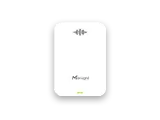
- LoRaWAN
- Class A, OTAA
- Band / port
- EU868 / port 85
- NH3 range
- 0 to 10 ppm, accuracy +/- 5%
- H2S range
- 0 to 5 ppm, accuracy +/- 5%
- Sensing principle
- Solid polymer electrochemical
- Local alarm
- LED light and buzzer on threshold
- Configuration
- NFC (Milesight ToolBox)
What the GS301 measures
Ammonia (NH3)
Electrochemical cell, 0 to 10 ppm, reported as ppm (raw / 100).
Hydrogen sulfide (H2S)
Electrochemical cell, 0 to 5 ppm, reported as ppm (channel 05, raw / 100 up to firmware v1.1; channel 06, raw / 1000 from v1.2).
Temperature
Ambient temperature in degrees Celsius (INT16, /10).
Humidity
Relative humidity 0 to 100 % RH (raw / 2).
Battery level
Reported periodically with local storage and retransmission.
Integration
Sensor / controller
Measures or controls in the field and sends LoRaWAN uplinks.
LoRaWAN gateway
Receives the radio packets and forwards them to the server.
ChirpStack
Network server: manages sessions and decodes the payload.
ThingsBoard / Grafana
Dashboards, alarms, rules and reports.
function decodeUplink(input) {
  var bytes = input.bytes;
  var data = {};

  for (var i = 0; i < bytes.length; ) {
    var channel = bytes[i++];
    var type = bytes[i++];

    if (channel === 0x01 && type === 0x75) {          // battery (%)
      data.battery = bytes[i]; i += 1;
    } else if (channel === 0x02 && type === 0x67) {   // temperature (degC)
      data.temperature = readInt16LE(bytes, i) / 10; i += 2;
    } else if (channel === 0x03 && type === 0x68) {   // humidity (%RH)
      data.humidity = bytes[i] / 2; i += 1;
    } else if (channel === 0x04 && type === 0x7d) {   // NH3 (ppm)
      var nh3 = readUInt16LE(bytes, i); i += 2;
      if (nh3 === 0xfffe || nh3 === 0xffff) {
        data.nh3_status = nh3 === 0xffff ? "device_error" : "polarizing";
      } else {
        data.nh3 = nh3 / 100;
      }
    } else if (channel === 0x05 && type === 0x7d) {   // H2S (ppm), firmware <= v1.1
      var h2s = readUInt16LE(bytes, i); i += 2;
      if (h2s === 0xfffe || h2s === 0xffff) {
        data.h2s_status = h2s === 0xffff ? "device_error" : "polarizing";
      } else {
        data.h2s = h2s / 100;
      }
    } else if (channel === 0x06 && type === 0x7d) {   // H2S (ppm), firmware >= v1.2
      var h2s12 = readUInt16LE(bytes, i); i += 2;
      if (h2s12 === 0xfffe || h2s12 === 0xffff) {
        data.h2s_status = h2s12 === 0xffff ? "device_error" : "polarizing";
      } else {
        data.h2s = h2s12 / 1000;
      }
    } else {
      break;
    }
  }
  return { data: data };
}

function readUInt16LE(b, i) {
  return (b[i + 1] << 8) | b[i];
}

function readInt16LE(b, i) {
  var v = readUInt16LE(b, i);
  return v > 0x7fff ? v - 0x10000 : v;
}
Implemented from the published Milesight byte specification (Communication Protocol / User Guide).
Channel format: 01 75 battery (%), 02 67 temperature (INT16 little-endian, /10), 03 68 humidity (/2), 04 7d NH3 (UINT16 little-endian, /100, ppm). H2S moved channel between firmware revisions: 05 7d (/100, ppm) up to v1.1 and 06 7d (/1000, ppm) from v1.2, so the decoder handles both. The raw values 0xFFFE and 0xFFFF on a gas channel are not real readings: 0xFFFE means the electrochemical cell is still polarizing and 0xFFFF flags a device error, so the decoder maps them to a status field. Implemented from the published Milesight byte specification. For ThingsBoard the same logic goes into an uplink converter.
Uplink (hex)
01756402670A01036864047D0000057D0100Decoded JSON
{ "battery": 100, "temperature": 26.6, "humidity": 50, "nh3": 0, "h2s": 0.01 }Use cases
Smart restroom monitoring
Track NH3 and H2S in public toilets and trigger cleaning when odor rises.
MoreSmart office & buildings
Keep washrooms and shared facilities fresh with data-driven cleaning schedules.
MoreSmart retail facilities
Monitor customer restroom air quality and dispatch staff before complaints arise.
MoreConfiguration & pitfalls
NFC setup
Keys, reporting interval and NH3/H2S thresholds are set over NFC with the Milesight ToolBox before rollout.
Warm-up period
Electrochemical cells need a warm-up after power-on. Early uplinks may carry a status flag instead of a reading; suppress alarms until valid values arrive.
Calibration drift
Electrochemical gas cells drift over time. Schedule periodic calibration with the ToolBox and document the offset so dashboard readings stay traceable.
Threshold alarms & D2D
When NH3 or H2S crosses the threshold the device triggers a local LED and buzzer and can fire a D2D command to a ventilation relay without a gateway. Account for D2D events in monitoring.
How merkaio supports your GS301
From sourcing to day-to-day operation, all from one partner on our own European infrastructure.
Pre-staging & provisioning
We configure the GS301, set keys, intervals and alarms, and ship it ready to deploy.
Own decoder
Payload codec for ChirpStack v4 and ThingsBoard, implemented from the Milesight specification.
Dashboard integration
Data lands in your ThingsBoard or Grafana, with alarms and reports.
Operations & monitoring
We run the LoRaWAN stack and dashboards on European infrastructure, you just use the data.
Frequently asked questions
Let's discuss your infrastructure. Digital and on-site.
Whether it's IoT platform development, hardware selection, managed hosting for ChirpStack, ThingsBoard, Grafana or NetBird VPN, or migration from a self-hosted setup - we'll find the right solution for your use case. Book a free 30-minute consultation, no commitment required.

Your contact
Timo Wevelsiep
Founder, merkaio
15 minutes, no commitment, directly with Timo.
Decoder for ChirpStack v4. merkaio is an independent integrator and is not affiliated with Milesight.